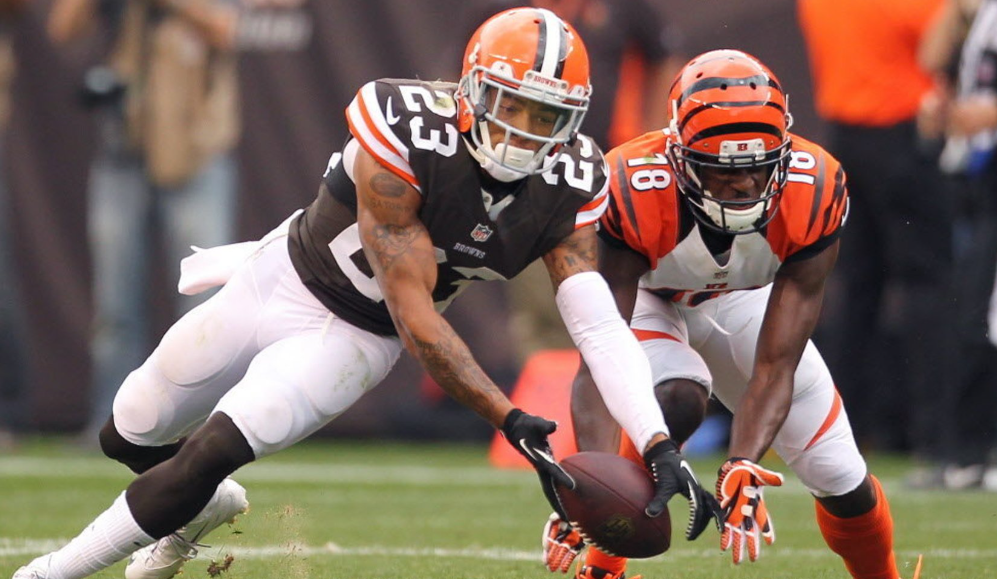
A cornerback plays one of the toughest positions in American football. Tasked with defending wide receivers, cornerbacks must react to routes without knowing where receivers will break, challenge passes, and keep short completions from turning into big plays. The job demands speed, precise footwork, quick decisions, and a strong understanding of offensive schemes.
Unlike defensive linemen, who work primarily near the line of scrimmage, cornerbacks often defend receivers in open space. One missed assignment can lead to a touchdown. Strong coverage, on the other hand, may never appear in the box score because the quarterback chooses to throw elsewhere.
The position involves much more than interceptions and pass breakups. Cornerbacks must handle different coverage assignments, support the run defense, tackle in space, and coordinate with the rest of the secondary.
What Is a Cornerback?
A cornerback (CB) is a defensive back whose primary responsibility is covering eligible receivers, particularly wide receivers. Most cornerbacks play near the outside edges of the defensive formation, although some specialize in defending receivers lined up inside.
The cornerback position is part of the secondary, a group of defensive backs that also includes safeties. These players handle much of the pass coverage while providing additional support against running plays.
A traditional base defense typically features two outside cornerbacks. Nickel packages add a fifth defensive back, often a slot cornerback, to counter formations with three wide receivers. Dime packages generally use six defensive backs when additional pass coverage is needed.
Receivers know their intended routes, while cornerbacks must identify those routes as they develop. Anticipation, positioning, and controlled movement help defenders respond to sudden changes of direction.
Although defending passes is their main responsibility, cornerbacks also play important roles against outside runs, receiver screens, and other plays that bring the ball toward the perimeter.
Main Responsibilities of a Cornerback
Cornerback responsibilities depend on the defensive scheme, offensive formation, and game situation. Some plays require tracking a particular receiver, while others involve defending an assigned area and reacting to routes entering that space.
Regardless of the coverage, cornerbacks must prevent easy completions, recognize developing plays, and make tackles when the ball reaches their side of the field.
Covering Wide Receivers
Cornerbacks work to limit the separation receivers create during their routes. They rely on positioning, footwork, and route recognition to stay close enough to challenge a pass without committing a penalty.
Their technique changes according to the coverage call. Some assignments require tight positioning near the line of scrimmage, while others give the receiver an initial cushion. In either case, the defender must maintain proper leverage and avoid giving the quarterback an easy throwing window.
Defending Passes
When a quarterback targets a covered receiver, the cornerback must react to the throw, locate the football, and attempt to break up or intercept the pass.
Timing is critical. Contact that illegally restricts a receiver can result in defensive pass interference or illegal contact penalties. Under NFL rules, defenders are generally prohibited from initiating contact that restricts an eligible receiver beyond five yards of the line of scrimmage, with certain exceptions. Separate restrictions apply when a forward pass is in the air.
A cornerback can win a matchup without making an interception. Forcing an incompletion, limiting yards after the catch, or discouraging quarterbacks from throwing his way can be just as valuable.
Supporting Run Defense
Cornerbacks must also respond when offenses run the ball. Depending on the defensive scheme, they may contain an outside run, force the ball carrier back toward inside defenders, or tackle a runner who breaks through the first level.
Against receiver screens, quick recognition is essential. The defender must identify the play, avoid or defeat blocks, and close on the ball carrier before the play develops into a significant gain.
Reliable tackling is particularly important near the sideline, where a missed attempt can allow a runner to gain substantial yardage.
Reading Offensive Formations
Before the snap, cornerbacks study receiver alignments, spacing, motion, and other clues that may reveal the offense’s intentions. A receiver’s position relative to the formation can help narrow the range of possible routes.
After the snap, defenders must recognize route combinations without abandoning their assignments. In zone coverage, watching the quarterback can help anticipate a throw, but focusing on him too early may leave a receiver uncovered.
Communication with safeties and linebackers becomes especially important when receivers cross the formation, the offense uses motion, or coverage responsibilities change after the snap.
Where Does a Cornerback Line Up on the Field?
Cornerbacks usually line up near the perimeter of the defensive formation, opposite wide receivers. Their exact positioning depends on the coverage call, offensive alignment, and available defensive help.
Outside cornerbacks commonly align near the field numbers or sideline. Slot cornerbacks play farther inside, often opposite receivers positioned between the outermost wide receiver and the offensive line.
The distance between a cornerback and the receiver is another important part of the alignment.
In press alignment, the defender starts close to the line of scrimmage. This positioning allows the cornerback to challenge the receiver’s release through leverage or legal contact. However, a poorly timed movement can leave the defender vulnerable to a deep route.
Off coverage creates an initial cushion, often several yards from the receiver. That space gives the defender more time to read the release and react to developing routes, although it can make short completions easier to concede.
Cornerbacks may also line up unusually deep, disguise their intended coverage, or participate in blitz packages. A defender might initially appear responsible for a receiver before rushing the quarterback, with another player rotating into the vacated coverage area.
Field position affects these decisions. Near the goal line, receivers have less space to run vertically, increasing the importance of quick reactions and leverage. On long-yardage downs, preventing a deep completion may matter more than contesting every short pass.
Different Types of Coverage Used by Cornerbacks
Cornerbacks operate within defensive systems designed to limit passing options. The two basic approaches are man-to-man and zone coverage, although modern NFL defenses frequently combine elements of both.
Man-to-Man Coverage
In man-to-man coverage, a cornerback is responsible for a specific eligible receiver rather than a fixed area of the field.
The defender generally follows that receiver throughout the route, adjusting to changes of direction, speed, and positioning. Success depends on maintaining leverage, reacting efficiently to cuts, and knowing when to turn and run.
Two common techniques are press-man and off-man coverage.
In press-man coverage, the cornerback begins close to the receiver. He may use a legal jam to disrupt the release or position himself to steer the route toward defensive help.
Off-man coverage starts with a cushion. The defender reads the receiver’s movement, maintains balance, and attempts to close the distance when the route breaks.
Man coverage can make passing windows difficult to find, particularly when defenders match up well against their assignments. The drawback is greater exposure to individual mismatches. A cornerback who allows a fast receiver to create separation may struggle to recover, especially without safety help.
Zone Coverage
In zone coverage, defenders protect designated areas of the field rather than following one receiver wherever he goes.
Cornerbacks must identify receivers entering their zones, recognize overlapping routes, and understand when responsibility shifts to another defender.
Several common coverage structures illustrate how their assignments change.
Cover 2: Two safeties typically divide the deep field into halves. Cornerbacks often defend the flats, influence receiver releases, and support the deeper coverage structure.
Cover 3: Three defenders divide the deep field into thirds. Outside cornerbacks frequently protect the deep outside thirds, while a safety covers the middle third.
Cover 4: Also known as quarters coverage, this structure distributes deep-field responsibilities among four defenders. Many versions use pattern-matching rules, requiring cornerbacks to carry certain routes rather than remain in fixed zones.
Modern defenses also employ match coverage, which combines zone-based assignments with man-like responsibilities once receivers develop their routes.
Zone concepts can help defenders protect vulnerable areas and react to the quarterback. However, effective execution depends on recognizing route combinations and maintaining coverage discipline. Offenses can exploit gaps between defenders, particularly when routes stretch a zone vertically or horizontally.
Essential Skills of a Good Cornerback
Athletic ability matters, but successful cornerbacks combine physical tools with technical discipline and a strong understanding of the game.
Speed and acceleration help defenders stay with receivers on vertical routes and recover when separation develops. Straight-line speed is valuable, but positioning and route anticipation often determine whether a cornerback can stay in coverage.
Agility and footwork allow defenders to change direction without losing balance. Controlled backpedaling, smooth hip transitions, and efficient foot placement help cornerbacks react to sharp cuts and sudden changes of pace.
Route recognition allows experienced defenders to anticipate where receivers are likely to break. Studying offensive tendencies, formations, and receiver releases helps reduce the time needed to react.
Ball skills determine how effectively a cornerback challenges a pass. Tracking the football, timing a jump, and securing an interception require coordination and concentration, particularly when the defender must locate the ball while staying with a receiver.
Physicality and tackling are essential against running plays, screens, and receivers gaining yards after a catch. Cornerbacks must handle contact, defeat blocks when necessary, and finish tackles without sacrificing technique.
Mental resilience is equally important. Even elite cornerbacks allow completions. A defender must recover quickly from a mistake because offenses may attack the same matchup again on the next play.
There is no single physical profile that guarantees success. Some cornerbacks rely on exceptional speed, while others compensate with anticipation, length, disciplined footwork, and an advanced understanding of offensive concepts.
Cornerback vs Safety and Other Defensive Positions
Cornerbacks and safeties both play in the defensive secondary, but their typical assignments differ.
Cornerbacks spend much of their time covering wide receivers, particularly near the perimeter. Safeties often operate deeper or closer to the middle of the field, providing coverage support, defending vertical routes, and reacting to running plays.
These distinctions are not absolute. Modern defenses frequently disguise coverages and interchange responsibilities before or after the snap.
| Position | Typical Alignment | Primary Responsibilities |
| Outside cornerback | Near the perimeter, opposite wide receivers | Outside pass coverage, run support, tackling |
| Slot cornerback | Inside, opposite slot receivers | Inside coverage, screens, run support, occasional blitzes |
| Free safety | Often deeper in the secondary | Deep coverage, route recognition, coverage support |
| Strong safety | Variable depth, sometimes closer to the box | Run support, coverage against tight ends and receivers, blitzing |
| Linebacker | Behind the defensive line | Run defense, underneath coverage, pass rushing |
Playing in the slot presents challenges that differ from those on the perimeter. Outside cornerbacks can use the sideline to limit a receiver’s available space. Slot defenders must cover routes breaking in either direction, often while navigating crossing receivers, tight ends, and nearby blockers.
The role demands quick lateral movement, awareness of route combinations, and reliable tackling.
Linebackers and defensive linemen generally have different priorities. Linebackers frequently defend runs, cover underneath passing routes, or rush the quarterback. Defensive linemen focus primarily on controlling the line of scrimmage, disrupting blocking schemes, and generating pressure.
Cornerbacks can also rush the passer. Defensive coordinators sometimes use cornerback blitzes to create pressure from unexpected angles, forcing the offense to account for an additional defender near the edge.
How Cornerbacks Are Evaluated in the NFL
The role of a cornerback in the NFL has evolved alongside increasingly sophisticated passing offenses. Defenders must handle complex route combinations, versatile receivers, and coverage schemes that frequently change after the snap.
Evaluating their performance involves more than counting interceptions. A defender who consistently prevents receivers from getting open may rarely be targeted, leaving fewer opportunities to produce visible statistics.
Coaches and analysts examine several performance measures alongside game film.
Interceptions record passes caught by a defender. They can change possession and field position, but totals depend partly on quarterback decisions, coverage assignments, and opportunities to make a play.
Passes defensed typically include interceptions and passes broken up by a defender. Pass breakups are also tracked separately by some statistical providers. These figures reflect plays made on the ball but do not capture every successful coverage snap.
Completion percentage allowed measures the proportion of targeted passes completed against a defender. A lower percentage can indicate effective coverage, although target difficulty and differences in statistical charting affect comparisons.
Yards allowed in coverage measures receiving yards attributed to a defender. Analysts may examine total yards, yards per target, or yards per coverage snap. Assigning responsibility becomes more complicated in zone and match coverages.
Touchdowns allowed count scoring receptions attributed to a defender. These numbers require context because a coverage breakdown may involve more than one player.
Penalties can reveal problems with coverage discipline. Defensive pass interference and illegal contact may extend drives or give an offense valuable field position even when a pass is incomplete.
Tackling efficiency is particularly relevant for slot cornerbacks and defenders involved in run support. Missed tackles can turn short completions or outside runs into substantial gains.
Why Coverage Statistics Need Context
Cornerbacks operate in different defensive systems and face different assignments. One player may regularly cover an opponent’s top receiver with limited safety help. Another may spend most snaps in zone coverage, where responsibilities are shared.
A defender who allows several short completions while preventing deep passes may be executing the defensive plan correctly. Conversely, a cornerback who rarely gets targeted is not automatically performing well. Low target volume may reflect tight coverage, offensive strategy, or the quarterback’s preference for other matchups.
Advanced statistics also depend on how analysts assign coverage responsibility. On a completion against zone defense, identifying which player was responsible for the receiver may require interpretation. Different charting services can reach different conclusions about the same play.
NFL teams therefore combine statistical analysis with film study. Coaches evaluate leverage, route recognition, communication, tackling, and performance against different receiver types.
Physical measurements and athletic testing can help assess prospects, but NFL success depends on how effectively those traits translate to game situations.
FAQ
What is the main job of a cornerback in football?
A cornerback’s primary responsibility is defending receivers and limiting successful passing plays. Cornerbacks cover routes, challenge throws, and prevent yards after the catch. They also support run defense and make tackles when the ball reaches their area.
What is the difference between a cornerback and a safety?
Cornerbacks typically cover wide receivers near the outside of the formation. Safeties often provide deeper coverage support, defend the middle of the field, and help against running plays. Their assignments can overlap depending on the defensive scheme.
Do cornerbacks have to be fast?
Speed is a major advantage because cornerbacks frequently defend receivers running deep routes. However, footwork, anticipation, positioning, and route recognition are just as important. A technically sound defender can compensate for some limitations in straight-line speed.
Can a cornerback tackle the quarterback?
Yes. A cornerback can sack the quarterback during a blitz or tackle him when he becomes a ball carrier. A sack generally occurs when a defender brings down a quarterback attempting to pass behind the line of scrimmage. Any contact must comply with NFL rules protecting passers.
What makes a cornerback successful in the NFL?
Successful NFL cornerbacks combine coverage technique, athletic ability, route recognition, ball skills, and disciplined decision-making. Coaches evaluate their performance through film study and multiple statistics rather than relying on interceptions alone.